+86-13349293098


Choosing the China Best Backhoe Cylinder Manufacturer for Global Buyers requires more than comparing prices. It demands practical knowledge of pressure, stroke length, mounting geometry, seal performance, and working conditions. A reliable Backhoe Cylinder must withstand digging shocks, muddy sites, changing temperatures, and repeated hydraulic cycles. Small design errors can cause leakage, uneven movement, or costly machine downtime.
Experienced manufacturers usually begin with detailed drawings or machine samples. They check bore diameter, rod size, retracted length, extended length, and port position before production. Quality teams may inspect steel tubes, piston rods, welds, seals, and chrome thickness at different stages. Pressure testing is essential. So is dimensional inspection. These steps create useful evidence for buyers, not just attractive promises.
Details matter greatly.
For global projects, dependable communication is equally important. A professional supplier should provide clear specifications, realistic lead times, packing photos, inspection records, and responsive technical support. Export experience can reduce misunderstandings, but it does not replace verification. Buyers should review samples, factory capabilities, warranty terms, and after-sales procedures before placing large orders. No manufacturer is perfect. Even a strong supplier may need improvement in documentation, customization speed, or response time. That honest assessment helps build better partnerships. The right Backhoe Cylinder manufacturer combines engineering discipline, production experience, transparent quality control, and a willingness to solve problems after delivery.
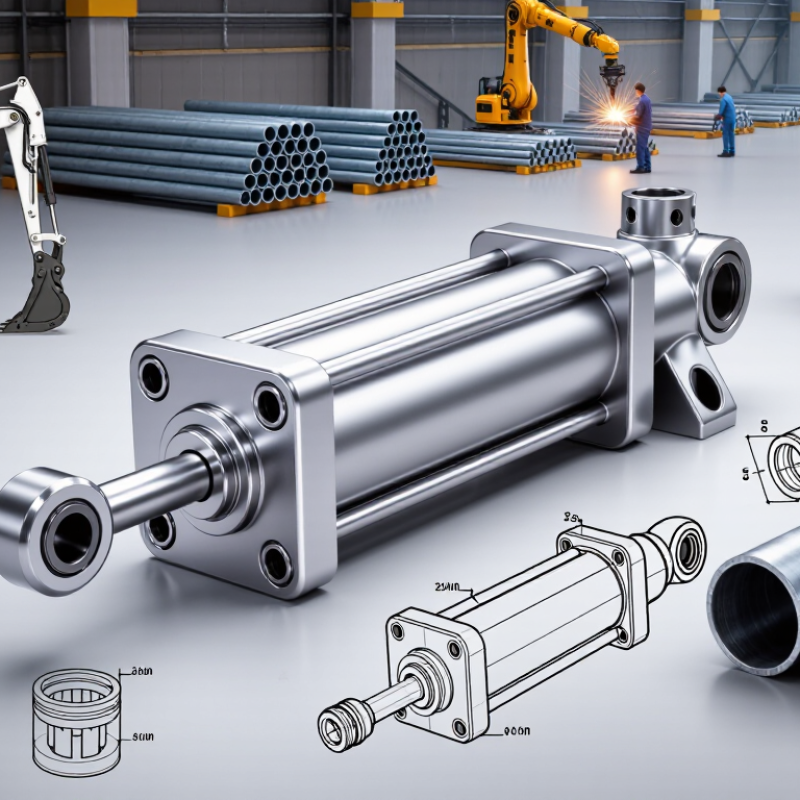
A backhoe cylinder converts hydraulic pressure into controlled movement. It raises the boom, moves the dipper, and opens the bucket. In practical operation, force depends on pressure and piston area. Speed depends on oil flow and piston displacement.
The main structure includes a steel barrel, piston, rod, gland, seals, and hydraulic ports. The barrel contains pressurized oil. The piston separates both working chambers. When oil enters one chamber, the piston and rod move outward. Oil leaves through the opposite port. Reversing the flow retracts the rod. This double-acting design supports movement in both directions.
Small details matter. A hardened, polished rod helps resist wear and corrosion. Properly fitted seals reduce leakage under changing loads. The gland guides the rod and protects the inner sealing area from dust. During manufacturing, dimensional checks, pressure testing, and surface inspections should be recorded clearly. Global buyers should also review material certificates and test data, not only photographs.
Field experience shows that alignment problems can damage even a well-made cylinder. Contaminated oil is another quiet threat. A single particle may score the sealing surface. It seems minor.
Regularly checking rod scratches, oil seepage, mounting pins, and hose connections can reveal early failure. Yet no inspection method is perfect. Temperature, overload, and poor maintenance still create uncertainty. That limitation deserves honest attention when selecting a backhoe cylinder supplier.
A reliable backhoe cylinder manufacturer must prove performance beyond a polished catalogue. The 2024 MarketsandMarkets hydraulic-cylinder assessment identifies construction equipment as a major demand area. This makes consistency critical for global buyers. Each cylinder should use tested steel, accurate honing, hardened rods, and seals suited to dust, heat, and hydraulic pressure. ISO 9001 quality control supports repeatable production, but certification alone cannot guarantee field reliability.
Manufacturing evidence matters more. Ask for pressure-test records, dimensional inspection reports, material certificates, and batch traceability. McKinsey reports that predictive maintenance can reduce downtime by 30–50% and lower maintenance costs by 20–30%. A manufacturer offering wear data and service feedback can help buyers plan replacements before leakage stops a machine. Still, laboratory results are not field reality. Even a strong cylinder may fail early when alignment is poor or contamination enters the system.
Check rod coating, seal materials, warranty limits, and delivery records. Confirm whether custom mounting dimensions are measured from drawings or samples. Small errors can create large installation problems. A dependable supplier also explains its weak points honestly. That is more useful than promising a “maintenance-free” cylinder, because no backhoe component works forever.
A China-based backhoe cylinder manufacturer should treat standards as daily controls, not marketing language. ISO 4413 guides hydraulic system safety, while ISO 9001 supports documented process management. The ISO Survey 2022 reported more than 1.2 million ISO 9001 certificates worldwide. That figure shows how widely controlled quality systems are expected by global buyers.
Reliable production begins with traceable steel, verified heat treatment, and controlled welding procedures. Each barrel should receive dimensional checks for bore size, roundness, and surface finish. Rods need chrome thickness testing and straightness inspection. Seals require batch records and compatibility checks. Assembly areas must control dust and moisture. Pressure testing should follow the approved design file, with recorded test pressure, holding time, and leakage results. A clean test bench matters.
Tips: Ask for material certificates, welding records, inspection plans, and pressure-test reports. Check whether every cylinder has a serial number.
Experience also reveals uncomfortable gaps. A perfect report cannot repair poor storage or rushed assembly. No inspection plan is flawless. Buyers should review failure feedback, not only first-pass data. Root-cause analysis, corrective action, and random destructive testing can expose weaknesses before field use. Clear acceptance criteria make supplier comparisons fairer and more reliable.
| Manufacturing Area | Control Dimension | Typical Specification or Acceptance Criteria | Applicable Standard or Reference | Quality-Control Method | Required Record |
|---|---|---|---|---|---|
| Design and Engineering | Rated working pressure | Typically 16–25 MPa, selected according to the excavator hydraulic system and duty cycle. | ISO 4413:2010; machine manufacturer requirements | Design review, pressure-rating calculation, and circuit compatibility check | Approved drawing and calculation report |
| Design and Engineering | Maximum allowable pressure | Must be defined separately from rated working pressure and verified by design calculation and pressure testing. | ISO 4413:2010; approved product specification | Engineering review and documented test plan | Technical specification and validation report |
| Cylinder Configuration | Bore, rod diameter, and stroke | Common backhoe-cylinder configurations use bore sizes of approximately 50–160 mm, rod diameters of 30–100 mm, and application-specific strokes. | Customer drawing and equipment interface requirements | Coordinate measuring machine, calibrated gauges, and dimensional inspection | Dimensional inspection report |
| Cylinder Configuration | Mounting dimensions | Pin diameter, center-to-center length, mounting width, port position, and rotation angle must match the approved installation drawing. | ISO 6020-2 or ISO 6022 where applicable; customer drawing | Gauge inspection, fixture verification, and trial assembly | Mounting-dimension checklist |
| Raw Materials | Cylinder tube material | Seamless or precision-finished steel tube with a verified material certificate; internal surface finish must support reliable seal performance. | Approved material specification; EN 10204 inspection documents | Material identification, certificate review, hardness check, and surface inspection | Material certificate and receiving inspection report |
| Raw Materials | Piston rod material and surface | Alloy or carbon steel selected for strength and fatigue resistance; chrome-plated or corrosion-resistant surface treatment may be specified for exposed rods. | Approved drawing and surface-treatment specification | Diameter, straightness, coating thickness, visual inspection, and surface roughness testing | Rod inspection and coating report |
| Welding | Welded joints | Welds must be free from visible cracks, lack of fusion, excessive porosity, and unacceptable undercut. Critical welds require a defined inspection level. | ISO 3834; ISO 5817 where applicable | Welding procedure qualification, welder qualification, visual inspection, and non-destructive testing when specified | Welding procedure, welder record, and NDT report |
| Machining | Bore and sealing surfaces | Finished bore diameter, cylindricity, and surface roughness must remain within the approved drawing limits to prevent internal leakage and premature seal wear. | Approved engineering drawing and seal supplier requirements | Internal micrometer, bore gauge, profilometer, and dimensional sampling | Machining inspection report |
| Machining | Piston-rod straightness | Typical production control limits are commonly set around 0.1–0.3 mm per metre, unless the approved drawing requires a tighter value. | Customer drawing and internal process specification | V-block and dial-indicator inspection or dedicated straightness equipment | Rod straightness record |
| Sealing System | Seal compatibility | Seal material must be compatible with the specified hydraulic fluid, temperature range, pressure, speed, and contamination level. | ISO 5597 where applicable; fluid and seal manufacturer data | Part-number verification, incoming inspection, and assembly checklist | Seal traceability record |
| Assembly | Cleanliness | Tube, piston, rod, ports, and internal components must be cleaned before assembly; no visible chips, abrasive particles, moisture, or foreign material are permitted. | ISO 4406 cleanliness target defined by the hydraulic system | Flushing, filtered air or fluid cleaning, visual inspection, and cleanliness sampling when required | Cleaning and flushing record |
| Pressure Testing | Proof pressure test | Test pressure and hold time must be defined by the approved product specification; no structural deformation or external leakage is permitted. | ISO 10100:2010; approved test procedure | Calibrated hydraulic test bench with documented pressure and holding time | Pressure-test certificate |
| Pressure Testing | Leakage inspection | No visible external leakage is accepted during the specified static and dynamic test sequence. Internal leakage limits must be defined for each cylinder design. | ISO 10100:2010; customer acceptance criteria | Static hold test, cycling test, and visual inspection of seals and ports | Leakage inspection report |
| Functional Testing | Extension and retraction movement | Full stroke must be completed smoothly without abnormal noise, stick-slip, binding, or uncontrolled drift under the defined test conditions. | Approved functional test procedure | Low-pressure movement test followed by operating-pressure cycling | Functional test record |
| Surface Protection | Paint and corrosion protection | Machined and exposed surfaces must receive the specified protection. Coating must be continuous, properly cured, and free from blistering, peeling, or exposed corrosion-prone areas. | ISO 12944 classification where specified; project coating specification | Visual inspection, coating-thickness measurement, and curing verification | Coating inspection report |
| Traceability | Part and batch identification | Each cylinder should be traceable to its drawing revision, material batch, seal batch, production date, and pressure-test result. | ISO 9001:2015 quality-management principles | Serial-number control and production-route-card verification | Traceability file and final inspection report |
| Documentation | Inspection package | Recommended documents include approved drawing, material certificates, dimensional report, welding records, pressure-test certificate, coating report, and packing list. | ISO 9001:2015; EN 10204:2004 where requested | Document review before release and shipment | Final quality dossier |
| Packaging and Export | Transport protection | Ports must be capped, exposed rods protected against impact and corrosion, and cylinders secured to prevent movement during handling and sea or road transport. | Approved packaging specification; destination-country requirements | Packaging audit, visual inspection, and shipping-mark verification | Packing inspection checklist and shipment photographs |
For global backhoe equipment buyers, cylinder customization begins with working conditions, not catalog dimensions. Off-Highway Research reported roughly 1.1 million construction equipment units sold worldwide in 2023. That scale exposes wide differences in soil, climate, transport limits, and maintenance skills. A cylinder for wet clay may need chrome protection, while desert fleets often require stronger seal protection against dust. Buyers can specify bore diameter, rod diameter, stroke length, mounting width, pin size, and working pressure. Hydraulic ports can also match existing hoses and fittings.
Small details matter. Very much.
Experienced engineers usually review duty cycles before selecting materials. Frequent trenching demands fatigue-resistant rods and carefully calculated wall thickness. Cold regions may require low-temperature seals and hydraulic compatibility. Coastal projects need better corrosion resistance on exposed surfaces. ISO 6020-1 and ISO 6022 provide useful dimensional and performance references, but local machine design still controls final specifications. According to a 2024 construction equipment market outlook from Research and Markets, replacement demand remains important as fleets age. That supports practical customization, not unnecessary complexity. Buyers should request pressure testing, dimensional inspection, surface-hardness records, and traceable material certificates. A clear drawing approval process reduces installation errors.
One point deserves reflection. More customization does not always mean better value. An unusual seal or oversized rod can increase downtime when replacements are needed. The strongest design balances load capacity, service availability, and total lifecycle cost. That balance is often missed.