Leave Your Message

How to Find the Best Backhoe Cylinder Supplier in China?

Choosing the right Backhoe Cylinder supplier in China requires more than comparing online prices. A cylinder may look suitable in a product photo, yet fail when its rod, bore, ports, or mounting pins do not match your machine. Experienced buyers check these details before discussing final costs. They also request drawings, material information, pressure ratings, and clear production samples.

A reliable supplier should explain how each cylinder is manufactured and tested. Ask about honing accuracy, chrome-plated rod quality, seal materials, welding procedures, and surface protection. Factory visits can reveal useful details, such as clean assembly areas, organized parts storage, and pressure-testing equipment. If a visit is impossible, request inspection videos, test records, and traceable documentation. Certifications can support credibility, but they should not replace practical verification.

Communication matters more than many buyers expect. A capable supplier will confirm your backhoe model, working conditions, attachment type, and expected operating hours. They should also discuss packaging, spare seal kits, replacement parts, warranty terms, and delivery responsibilities. Small details matter. A poorly protected rod can arrive scratched after a long sea shipment. No supplier is perfect. Even a strong factory may misunderstand a drawing or overlook a special operating condition. Therefore, written specifications and pre-shipment inspection remain valuable safeguards. This guide explains how to compare Chinese suppliers, evaluate technical competence, and build a dependable purchasing process. The goal is not simply to find the cheapest Backhoe Cylinder. It is to find a supplier that can deliver consistent performance, honest communication, and support after installation.
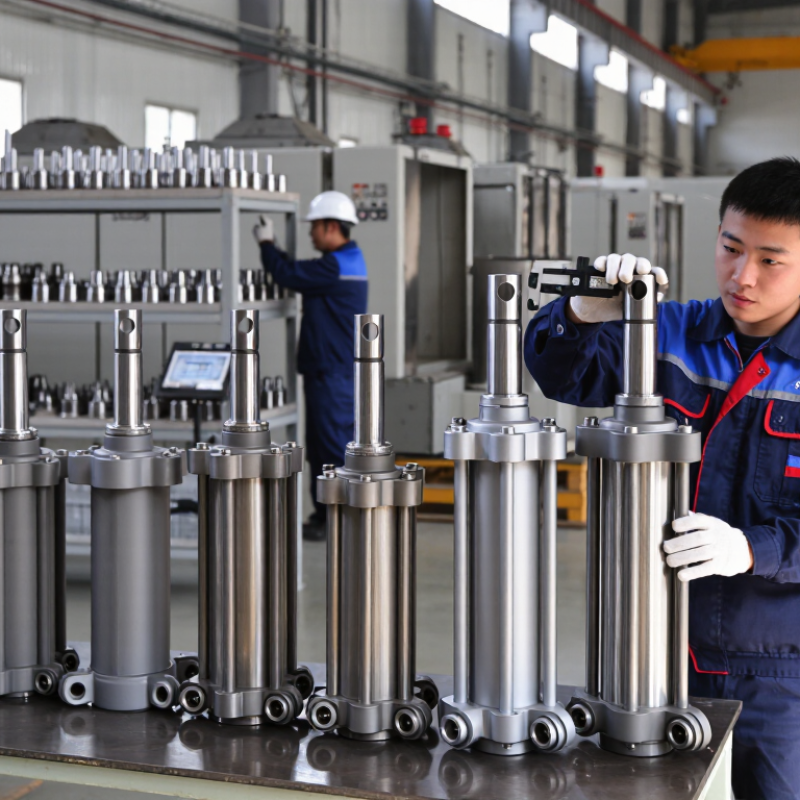
How to Find the Best Backhoe Cylinder Supplier in China?

Define Your Backhoe Cylinder Requirements

Before contacting a Chinese backhoe cylinder supplier, define the cylinder as a working component, not a generic spare. Record the backhoe model, attachment function, and cylinder position. Measure the bore, rod diameter, closed length, stroke, and pin diameters. Small errors matter. A two-millimeter mismatch can prevent installation or damage surrounding brackets. Use a calibrated caliper and steel tape, then confirm measurements twice. In field inspections, technicians often find that the original machine manual contains outdated dimensions.

Describe operating conditions clearly. State normal and peak hydraulic pressure, oil type, cycle frequency, and expected load. Include ambient temperatures, mud exposure, saltwater contact, and storage conditions. These details guide seal material, rod coating, welding, and surface protection. Specify mounting style, port thread, hose orientation, and preferred cushioning arrangement. Send photos with a ruler beside each connection. A drawing is better. However, drawings can contain old dimensions. Review them against the machine currently in service.

Ask the supplier for a dimensional drawing, material information, pressure test records, and an inspection plan. Request inspection points covering leakage, concentricity, and rod straightness. Confirm how replacement seals and spare components will be identified. Do not choose by price alone. A low quote may hide untested assumptions about pressure or fit. A common mistake is specifying maximum force without checking bracket strength. That oversight can shift failure elsewhere. Consider a prototype or first-article review before larger production. It takes time, but it exposes unclear requirements early.
Research Qualified Chinese Cylinder Suppliers

Research qualified Chinese cylinder suppliers by checking evidence, not polished catalogues. The China Construction Machinery Industry Association reported 195,018 excavator sales in 2023, including 104,214 exports. This figure signals a substantial equipment supply chain, but it does not prove any cylinder maker’s capability. Ask suppliers for production records covering comparable bore diameters, stroke lengths, and operating pressures. Request drawings, material certificates, pressure-test results, and traceability records for seals and steel tubes. A factory visit can reveal practical details: honing marks inside a barrel, clean assembly benches, and calibrated test equipment. Small details matter.

Confirm that the supplier can explain its process and share recent inspection data. Ask how it controls piston-rod chrome thickness, weld quality, and leakage after cycling. A documented test plan should state pressure, hold time, cycle count, and acceptance limits. Compare these records with the cylinder’s real duty cycle; a backhoe working in abrasive soil faces different demands from a light-duty machine. Check quality-system certificates directly with the issuing body, and verify that the certificate scope covers the relevant manufacturing site. References from buyers using similar equipment can add useful context, though they are not a substitute for testing. Some capable workshops may lack polished English documentation. That is worth discussing, not ignoring.

How to Find the Best Backhoe Cylinder Supplier in China? - Research Qualified Chinese Cylinder Suppliers

Evaluation Dimension What to Verify Practical Benchmark or Requirement Recommended Evidence Suggested Weight
Legal Business Qualification Confirm that the supplier is legally registered and authorized to manufacture or export hydraulic cylinders. Business registration, export capability, stable registered address, and consistent company information across documents. Business license, export documentation, factory address, and audited supplier profile. 8%
Quality Management System Assess whether production and inspection processes are controlled and documented. A current ISO 9001 certificate issued for the relevant manufacturing site is preferred. Certificate scope and validity should be checked independently. Certificate number, issuing body, validity period, audit scope, quality manual, and inspection records. 10%
Product Design Capability Determine whether the supplier can reproduce an existing cylinder or develop a customized design. Ability to provide 2D drawings, 3D models, load calculations, material specifications, and revision-controlled engineering documents. Sample drawings, engineering workflow, design-change records, and technical response time. 10%
Dimensional Compatibility Check whether the cylinder will fit the backhoe linkage and hydraulic system without modification. Verify bore, rod diameter, stroke, retracted length, mounting style, pin diameter, port position, thread type, and allowable installation clearance. Approved technical drawing, inspection report, dimensional inspection photos, and first-article sample. 12%
Pressure and Load Performance Confirm that the cylinder is designed for the machine's operating pressure and mechanical load. Rated pressure, proof-test pressure, thrust and return-force calculations, rod-buckling review, and safety factor should match the equipment design requirements. Pressure-test records, calculation sheets, test-stand specifications, and signed test reports. 14%
Materials and Surface Treatment Verify the materials and finishing processes used for the tube, piston rod, piston, gland, and welded components. Material certificates should be traceable to the production batch. Rod surface treatment, corrosion resistance, weld quality, and dimensional finishing must meet the approved drawing. Mill certificates, heat-treatment records, coating or plating reports, weld inspection records, and batch traceability. 10%
Seal and Contamination Control Evaluate seal compatibility with the hydraulic fluid, temperature range, pressure, and operating environment. Seal material, temperature range, pressure rating, cleanliness procedure, and installation method must be clearly documented. Seal datasheets, assembly instructions, cleanliness records, and leak-test results. 8%
Testing and Inspection Review the supplier's final inspection system before shipment. Every finished cylinder should receive documented dimensional, visual, functional, and leakage checks. Pressure testing should follow the approved specification. Inspection and Test Plan, calibration certificates, pressure-test chart, leak-test report, and certificate of conformity. 12%
Prototype and Sample Process Check how the supplier handles sampling, corrections, and approval before mass production. A controlled first sample should be produced from an approved drawing, inspected against critical dimensions, and formally approved before batch production. Sample approval form, measurement report, nonconformity records, and corrective-action report. 8%
Production Capacity and Lead Time Assess whether the supplier can meet volume, delivery, and continuity requirements. Capacity should be supported by identifiable machining, welding, assembly, painting, testing, and warehousing resources. Lead time must be stated for samples and repeat orders. Capacity plan, production schedule, bottleneck analysis, on-time delivery records, and contingency plan. 8%
Traceability and After-Sales Support Verify that defects can be investigated and replacement parts can be supplied. Each cylinder should be linked to a production batch, drawing revision, inspection record, and seal or spare-parts information. Serial-number system, warranty terms, complaint procedure, root-cause reports, and spare-parts list. 6%
Commercial and Logistics Capability Compare the complete delivered cost rather than the unit price alone. Evaluate tooling, packaging, freight, insurance, duties, payment terms, minimum order quantity, and total landed cost. Formal quotation, Incoterms, packaging specification, freight estimate, payment terms, and cost breakdown. 6%
Total Evaluation Weight 100%
Recommended selection method: Request the same technical package from each shortlisted supplier, validate certificates and test records, inspect the manufacturing site when practical, approve a first sample, and score each criterion using documented evidence rather than price alone.

Evaluate Quality, Materials, and Manufacturing Standards

How to Find the Best Backhoe Cylinder Supplier in China?

Evaluate Quality, Materials, and Manufacturing Standards

A backhoe cylinder works under repeated pressure, shock, and exposure to grit. Ask suppliers for material certificates linked to each cylinder’s heat number, not just a general quality brochure. Check the rod’s coating thickness, surface finish, and hardness records. Inspect weld samples and dimensional reports for the barrel, ports, and mounting eyes. Small defects matter.

Fluid cleanliness matters, too. Machinery Lubrication’s hydraulic contamination guidance estimates that contamination contributes to roughly 70–80% of hydraulic system failures. Ask how cylinders are cleaned, sealed, and protected before shipping.

ISO 4406:2021 classifies fluid cleanliness using particle counts at 4, 6, and 14 micrometres. A supplier should explain how its flushing and cleanliness checks relate to your equipment requirements. A certificate alone is not proof. Request traceable pressure-test records, inspection criteria, and a sample quality report.

Then compare the documents with the physical part. A neat finish can hide weak process control, and paperwork can miss a rough seal groove. I would not skip that check.

Compare Prices, Lead Times, and Customization Options

How to Find the Best Backhoe Cylinder Supplier in China?

Price alone misleads. Compare complete costs, not only the quoted cylinder price. Grand View Research valued the global hydraulic equipment market at approximately USD 49.1 billion in 2023. It also projects a 4.7% annual growth rate through 2030. This demand creates more supplier choices, but quality levels still vary. Request itemized pricing for steel, seals, machining, testing, packaging, and delivery. Compare the same specifications, including bore, rod diameter, stroke, mounting style, and working pressure. Ask whether the quotation uses FOB, CIF, or another Incoterm. I have seen a low quote become expensive after tooling and replacement seals were added.

Lead time needs two figures: production time and transport time. The World Bank’s 2023 Logistics Performance Index gave China a score of 3.7 out of 5. That supports strong logistics capability, but port congestion and seasonal factory closures can still affect delivery. Request a written schedule for drawing approval, prototype production, batch manufacturing, inspection, and dispatch. Customization may include chrome thickness, rod coating, welded mounts, cushioning, sensors, and seal materials. Confirm tolerance data and test pressure before ordering. ISO 9001 certification is useful, but it does not replace sample inspection. A practical check includes measuring bore accuracy, rod straightness, weld quality, and leakage after cycling. Details matter. I would also ask for three recent inspection records, because one successful sample proves very little.

Verify Samples, Certifications, and After-Sales Support

A backhoe cylinder may look flawless on a quotation sheet. The sample tells a more useful story. Ask for a production-equivalent unit, not a hand-finished display piece. Measure rod diameter and stroke, inspect welds and chrome plating, then run pressure and leakage tests. Record the results. A single sample cannot prove every batch will match, so request inspection records tied to serial or batch numbers.

Check certificates directly with the issuing body. Confirm that the certificate is current and covers the factory and processes making your cylinder. The ISO Survey 2022 reported about 1.26 million valid ISO 9001 certificates worldwide. That large number is a reminder: certification is common, not a guarantee of product performance. Ask for material traceability, pressure-test procedures, and corrective-action records. Paperwork can look convincing. Verify it.

After-sales support should be specific before payment. Get written warranty terms, response times, and a list of replacement seals and other wear parts. Ask who pays freight for a confirmed defect and how the supplier handles urgent field failures. A practical test: send a technical question and note how quickly the team replies, and whether its answer addresses your cylinder dimensions. I would not rely on a vague promise of “lifetime support.” That wording sounds reassuring, but it leaves too much unclear.